Medical Terms Glossary
Medical Terms Glossary
Hello! My name is Anais and I'm a college student at Ahunstic. I'm currently doing the Springboard to DCS program. I will change college in September to start a three-year program in Nursing. I can't wait! Nursing is a profession within the health care sector focused on the care of people. Nurses practice in many specialties such as emergency, cardiovascular and perinatal. But the specialty that is the most interesting to me is pediatric. I love children and my dream is to care for them. I made this glossary to help other students understand some terms that are related to my field of study. I think that most people know what nursing is, but there are a lot of medical terms that are harder to understand. This glossary is there for that. I made a short list of 20 common terms related to nursing. Then, I added a definition for each term and some pictures to make it even easier to understand. I looked on Wikipedia and google to help me find the terms and the definitions. I hope this glossary will help you because it helped me!
- ABC
- noun
- This is the simple way to remember “airway, breathing, circulation,” which is the order in which nurses assess and prioritize a patient who is unresponsive or unconscious.
- Example: they continued to recommend the ABC approach with two rescue breaths preceding cardiac massage
- en: ABC

- Basic metabolic panel (BMP)
- noun
- BMP refers to a routine blood test that measures basic body functions, like kidney effectiveness and sugar levels. It measures eight different substances in your blood.
- Example: A BMP was done on the patient.
- en: Bilan métabolique de base (BMB)
- Biopsy
- noun
- the removal and examination of tissue, cells, or fluids from the living body
- Example: Core needle biopsies usually result in more bruising than a breast fine needle biopsy.
- en: biopsie
- catheter
- noun
- a flexible tube inserted through a narrow opening into a body cavity, particularly the bladder, for removing fluid.
- Example: The nurse removed the catheter from the bladder.
- en: cathéter
- Chart
- noun
- The medical documentation that follows a patient throughout a healthcare facility. It includes medical history, diagnoses, test results, dosage and timing of medications, and other relevant information.
- Example: A hospital chart is a legal document.
- en: dossier
- Code blue
- The term "code blue" is a hospital emergency code used to describe the critical status of a patient. Hospital staff may call a code blue if a patient goes into cardiac arrest, has respiratory issues, or experiences any other medical emergency.
- Example: The nurse had to call a Code Blue.
- en: Code bleu
- CPR
- noun
- Cardiopulmonary resuscitation (CPR) is an emergency procedure commonly used when a patient has stopped breathing.
- Example: She performed CPR on the patient.
- en: CPR
- defibrillator
- noun
- Defibrillators are devices that restore a normal heartbeat by sending an electric pulse or shock to the heart. They are used to prevent or correct an arrhythmia, a heartbeat that is uneven or that is too slow or too fast. Defibrillators can also restore the heart's beating if the heart suddenly stops.
- Example: The defibrillator saved his life
- en: défibrillateur
- Diagnosis
- noun
- the act of identifying a disease, illness, or problem by examining someone or something.
- Example: The unusual combination of symptoms made accurate diagnosis difficult
- en: Diagnostic

- dialysis
- noun
- Dialysis is a treatment for people whose kidneys are failing. When you have kidney failure, your kidneys don't filter blood the way they should. As a result, wastes and toxins build up in your bloodstream. Dialysis does the work of your kidneys, removing waste products and excess fluid from the blood
- Example: Once a patient starts dialysis, even if he or she is doing in-home treatment, the patient will need to be followed by a dialysis clinic
- en: dialyse

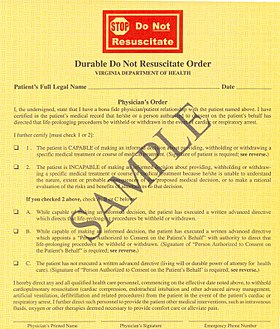
- DNR
- noun
- A do-not-resuscitate order (DNR) is a medical order, written or oral depending on country, indicating that a person should not receive cardiopulmonary resuscitation (CPR) if that person's heart stops beating.
- en: NPR (ordre de ne pas réanimer)
- gauze sponges
- noun
- Gauze sponges are disposable medical supplies commonly used in medicine and surgery. They are ordinarily made of gauze and are used to absorb blood and other fluids as well as clean wounds. When used in surgery, they are called surgical sponges.
- Example: Sterilize all surgical instruments and gauze sponges.
- en: Éponge de gaze
- I.V. therapy
- noun
- Intravenous therapy is a medical technique that delivers fluids, medications and nutrients directly into a person's vein.
- Example: IV therapy is the fastest way to deliver medication.
- en: Thérapie intraveineuse
- NICU
- noun
- Neonatal Intensive Care Unit. A hospital ward or department equipped and staffed to provide intensive care to dangerously ill or premature newborn babies.
- Example: Most of these babies go to the NICU within 24 hours of birth.
- en: L'unité de soins intensifs néonatals.

- pathology
- noun
- Pathology is the study of the causes and effects of disease or injury
- Example: a professor of pathology
- en: pathologie

- Prognosis
- noun
- A prognosis is a doctor's opinion about how someone will recover from an illness or injury. It is a prediction or estimate of the chance of recovery or survival from a disease.
- Example: Right now, doctors say his prognosis is/isn't good.
- en: pronostic
- Pulse oximeter
- noun
- The pulse oximeter, or Pulse Ox, is an electronic device that measures the saturation of oxygen carried in your red blood cells. Pulse oximeters can be attached to your fingers, forehead, nose, foot, ears or toes.
- Example: He used the pulse oximeter on his finger
- en: oxymètre de pouls
- Sphygmomanometer
- noun
- instrument for measuring blood pressure. It consists of an inflatable rubber cuff, which is wrapped around the upper arm and is connected to an apparatus that records pressure, usually in terms of the height of a column of mercury or on a dial (an aneroid manometer).
- Example: Most sphygmomanometers were mechanical gauges with dial faces.
- en: Sphygmomanomètre
- stethoscope
- noun
- a medical instrument for listening to the action of someone's heart or breathing, typically having a small disk-shaped resonator that is placed against the chest, and two tubes connected to earpieces.
- Example: Stethoscopes are an essential tool in many medical professions.
- en: stéthoscope
- tourniquet
- noun
- A tourniquet is a device that is used to apply pressure to a limb or extremity in order to limit – but not stop – the flow of blood. It may be used in emergencies, in surgery, or in post-operative rehabilitation.
- Example: He has a tourniquet on his arm
- en: tourniquet

Comments
Post a Comment